

 Credit: nft now
Behind the PFP: How Waleswoosh Built an Empire by Writing Threads for Fun


Share


-


-
COPIED

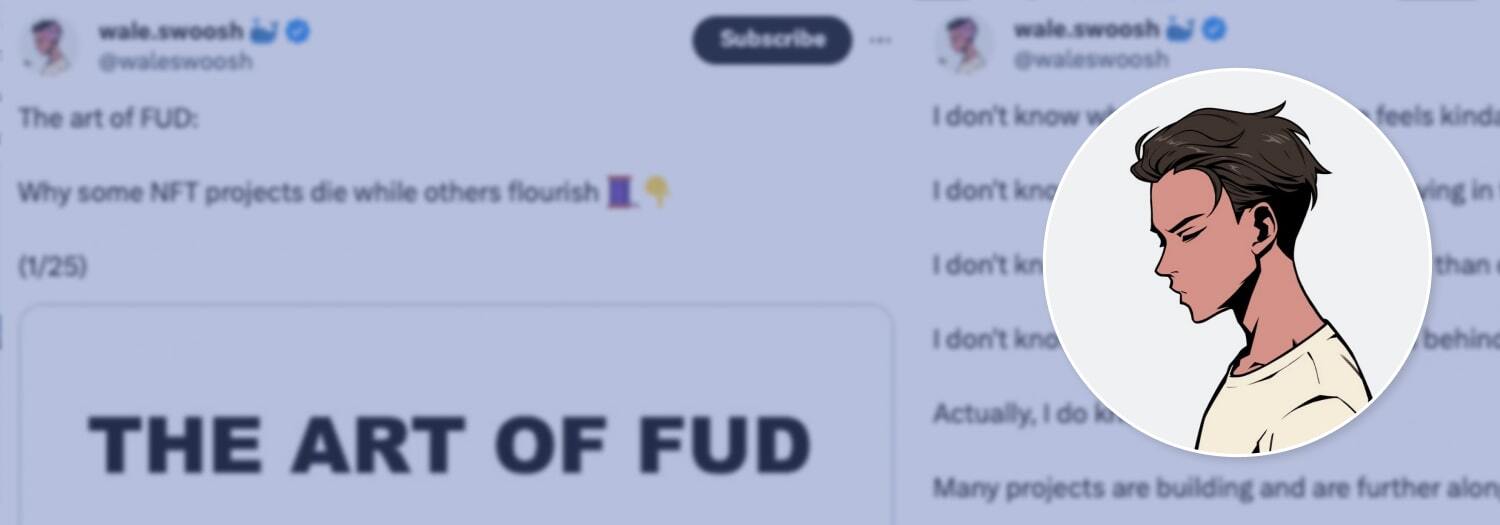
Waleswoosh, also known as “Wale,” has emerged as a leading voice in the Web3 community over the past year. Becoming nearly synonymous with the word “threads,” he has carved a niche in the space and grown it into a highly engaged community. With an X (formerly known as Twitter) following of more than 71,000 enthusiasts and a dedicated Discord channel boasting more than 1,200 members, he holds the No. 1 spot for global reach among Web3 creators on X, according to statistics from NFT Inspect.
However, this success didn’t come overnight. He dedicated extensive hours to trial and error, adapting and exploring different approaches to get to where he is today. Wale joins nft now for an exclusive interview to share more about himself— the man behind the PFP— as well as valuable and actionable insights on how content creators can grow their brands.
Wale Watching
nft now: When did you get into NFTs?
Waleswoosh: I got into crypto in early 2021. I got into crypto a few months before joining the NFT space. During the time I got into crypto, I was still in university; I got my degree in Business Administration. In 2021, I was in my last year of university, and that’s when I discovered NFTs. In the beginning, it started with day trading. Since I was a student at university. It was a good feeling to make some money on the side.
How and when did you start creating content?
So I actually started my more serious content creation journey with shitposting. I tried that. It wasn’t really successful. And then, over time, I found my niche. I found what I enjoyed doing. It was more informational or educational threads about what was happening in Web3 in the beginning. It was really just sharing my experiences or the other knowledge I got from trading NFTs from being in the space for a while, and that’s kind of how it all started.
WALESWOOSH
“I tried doing shitposting and memes, but long-form written content excited me.”
How did you know your niche was your niche?
It wasn’t really from the standpoint of trying to find my niche. In the beginning, it was more about trying to find my authentic voice. They are people who are successful in doing a lot of different things. I tried doing shitposting and memes, but long-form written content excited me. I always loved to write. Even though I didn’t get too much attention, I still enjoyed doing it and writing. So, I thought if I was going to create content like this, I should really pick something that I enjoy doing. I started to find my passion and run with it.
How did you get involved in the Azuki community?
I was always a holder in the Azuki ecosystem in some way, whether it was an Azuki or through Beanz. But, the real significant moment was when I became a Researcher in Residence at Azuki. It is an interesting story of how that came to fruition. Locationtba was the first big founder to slide into my DMs and say, “You’re doing a good job with your content.”
Back then, I was on my way up as a creator and wasn’t huge in my following, but it was a really big deal to have a founder show appreciation for the content I did in the space. Then, we had casual conversations, sharing thoughts on topics. One day, Locationtba asked me to go on a call. I didn’t think it was a serious topic or job offer, but he said in the second half of the call, “Hey, we have this program if you’re interested. Maybe we can work together.” That was the start. I attribute so much of my growth to this meeting because it was a huge driver [to me] as a creator. I’m grateful to Azuki and Locationtba for being the first person to reach out and give me this opportunity.
Did you find success right away, or was it more gradual?
I think what’s always interesting to me is the time I spend reading content prior to getting a paid position. I think it was trial and error for a long period. When I started doing threads, they weren’t doing well. For the first eight months, they didn’t do well. Sometimes, they did decently. It took a long period to pop off and get some reach within Web3. When I think of this journey of growing an audience and becoming the creator I am today— it is from the early days that was beneficial that made me grow from thread to thread to improve because I didn’t have the pressure of thousands of people reading it and criticizing. I tried to improve every time I wrote a thread. I asked myself, ‘What did I do differently this time?’ I found a good way to write the content itself but present it in a way that people want to read and want to share.
Waleswoosh
“When I started doing threads, they weren’t doing well… It took a long period to pop off and get some reach within Web3.”
You mentioned that you’re expanding to doing more video content. What else is next for you?
I’m not doxxed, so it won’t be me talking and my face on camera, but I’m working with a good team and creating a filter that looks like my Azuki. So, we’re excited to show the community the content utilizing this. Also, I’m working on something for spaces I’ll share more on soon.
Do you see yourself doxxing anytime in the near future?
I never thought it was necessary for me to doxx, so that’s probably one of the main reasons why I haven’t done it yet, but especially when I go more into the video direction, who knows what the X platform or what my content will look like half a year from now? It could be very possible that you will see Wale phase two and not just the PFP.
Content Creation Alpha
What lessons did you learn about what kind of threads perform and what kind of topics get a lot of shares?
The main learning from my first few months is that space moves fast, so what’s relevant won’t be relevant in a day or a week. I used to try to be the first to talk about a project’s news. I try to produce content around topics that people are discussing in the space. From an analytical standpoint, the space is moving so fast; people like talking about the stuff that happened today and not two weeks ago. So it’s good to capture the attention and go where the attention goes.
What do you think is the next trend for Web3 content creators?
There are a lot of people doing Threads, and a lot of people are doing memes, but I think the next area of content Web3 could progress in is video. I think it could be interesting. There are not a lot of people producing video content consistently. It comes back to me doing Threads in the early days. I wasn’t the only one doing it, but I was one of the only ones doing it consistently multiple times a week. A few months down the line, I think it could be the next hot medium.
“I think the next area of content Web3 could progress in is video… There are not a lot of people producing video content consistently.”
Waleswoosh
So you have figured out X threads as an art form. What are the best practices you follow that resonate on this platform?
Break up your paragraphs. A big one is paragraphs and breaking big parts of content down into a few lines. I think that’s easier to read. It was one of the first changes I made to my threads to really break up those long paragraphs into shorter ones because it’s easier to read and more fun to read.
Attach images to your tweets. Another thing I learned from the early days of trying to do threads was attaching pictures to the individual tweets. That works pretty well, too; it just makes it more fun to read and easier to follow when you have a graphic or an image that backs up what you’re saying in your tweet.
Don’t make your content too long. That’s another thing I learned in the beginning: I did threads with 30 or 40 tweets. So I learned to break down what I read, the essence of what I tried to say, like in maybe 10-15 tweets. So it’s not too long to wait because sometimes even I notice that with myself, like when I see a thread, the topic can be really interesting.
Have a good hook. Things like picking a good sticky headline, a sticky hook, and a good thumbnail image are also important. Tweets that show the importance of having a good hook, too.
I think at the end of the day— it comes down to trying to grab attention and capture attention. And on top of that, we’re in a space where the attention flows pretty fast from topic to topic. So I think it’s important to really try to optimize for gaining attention and maintaining it.
This interview transcript has been edited for concision and clarity.
Listen to our Twitter Space with Waleswoosh for the full and uncut interview.
